

Signs you may need a root canal
Sometimes there are no symptoms and the infection is found on a routine X-ray. Only an examination and X-ray can confirm whether root canal treatment is needed.
Why the nerve becomes inflamed or infected
Fees and subsidies
| Tooth | Our fee (incl. GST) | MOH fee benchmark | Max CHAS subsidy (Orange / Blue / MG / PG) |
|---|---|---|---|
| Front tooth (incisor, canine) | $500 | $400 – $775 | $217.50 / $326.00 / $331.00 / $336.00 |
| Premolar | $650 | $500 – $900 | $308.50 / $462.50 / $467.50 / $472.50 |
| Molar | $1,000 | $872 – $1,400 | $389.50 / $584.50 / $589.50 / $594.50 |
Fees exclude the core build-up, crown and any additional fillings, which are quoted separately before you decide. CHAS subsidy is claimed when the root canal is completed and shown on your itemised bill.
What treatment involves
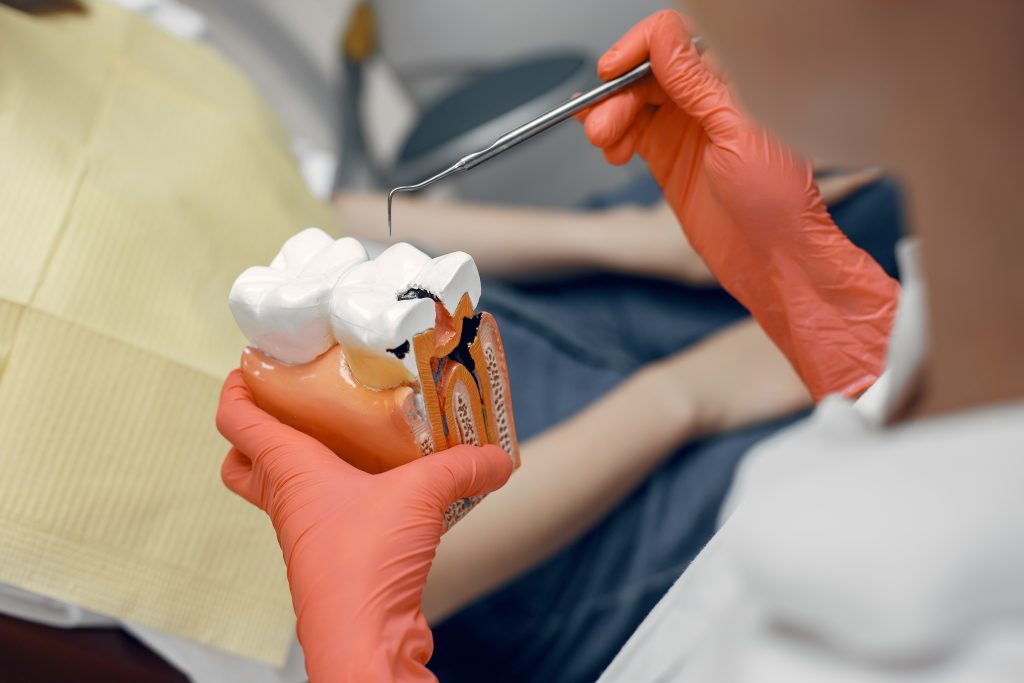
Recovery
- Eat soft foods for 2 to 3 days and chew on the other side until the permanent restoration is placed.
- If you need pain relief, ask your dentist, who will take your other medicines and any allergies into account.
- Contact us if swelling increases, pain is severe, or the temporary filling comes out.
Why a crown is recommended afterwards
The crown is quoted separately at your consultation. Permanent crowns are CHAS-claimable and eligible for Flexi-MediSave for patients aged 60 and above.
Keeping the tooth or extraction
Where the tooth is restorable, root canal treatment and a crown keep your natural tooth, preserve the surrounding bone, avoid surgery and usually cost less than extraction followed by an implant. This matters more if you take bisphosphonate or other anti-resorptive medication, have had head and neck radiotherapy, are immunocompromised, or have diabetes that is not well controlled. If the tooth is cracked through the root or has too little structure left, extraction may be the realistic option, and we will tell you.
Questions patients ask
How much is a root canal at Toothsmith?
$500 for a front tooth, $650 for a premolar and $1,000 for a molar, inclusive of GST, within the MOH fee benchmark ranges. The core build-up and crown are quoted separately.
Is root canal treatment covered by CHAS?
Yes, up to 2 per calendar year across all tooth types. For a molar the cap is $584.50 (CHAS Blue), $389.50 (CHAS Orange), $589.50 (Merdeka Generation) and $594.50 (Pioneer Generation). Permanent crowns are also CHAS-claimable.
Can I use MediSave for a root canal?
Standard MediSave cannot be used. If you are aged 60 or above, Flexi-MediSave allows up to $400 a year towards root canal treatment and permanent crowns, on top of any CHAS subsidy.
Does a root canal hurt?
It is done under local anaesthetic and should not be painful; it relieves the pain from the infected nerve. Mild to moderate tenderness on biting is normal for 2 to 4 days. If you need pain relief, ask your dentist.
How many visits does it take?
One or two, depending on the diagnosis. The crown is then made over a further one or two visits.
What happens if I leave an infected tooth untreated?
The infection can spread into the bone around the root tip and form an abscess, causing swelling and bone loss. The tooth may eventually need extraction.
Related dental questions
Questions about a painful tooth?
Book an assessment. You will see the X-ray, hear the options and know the fee before anything is done.